

14 Day Water Fast: The Pros, The Cons, and the Weird Stuff Nobody Warned Me About
One important part of my body went into hibernation

Fourteen days. No food. Just water, electrolytes, stubbornness, and the occasional thousand-yard stare at my buddy eating a noodle bowl.
When I told people I was doing a 14-day water fast, reactions ranged from “That’s impressive” to “Are you joining a cult?” to “You know snacks exist for a reason, right?”
And honestly? By Day 3, I wasn’t entirely sure they were wrong.
Still, I finished it. And looking back several weeks later, I can say this: it was one of the strangest, hardest, and most eye-opening things I’ve ever done.
Some parts felt incredible. Some parts felt ridiculous. A few parts felt like my body quietly powering down nonessential systems, like an old spaceship trying to conserve oxygen.
Here’s what happened.
Why I Did a 14 Day Water Fast
I mainly wanted to reset a few things.
I had ongoing inflammation issues, joint pain, food cravings (psychological and physical), and a stubborn skin rash that kept flaring up. I was also excited about the mental side of fasting. What happens when you remove food completely?
Not “skipping breakfast.”
Not “cutting carbs.”
Not “having a salad while secretly thinking about fries.”
I mean, completely removing food from the equation.
Turns out, your brain has a lot to say when the kitchen closes indefinitely.
The Biggest Pro: Weight Loss
Let’s address the big fat elephant in the room first.
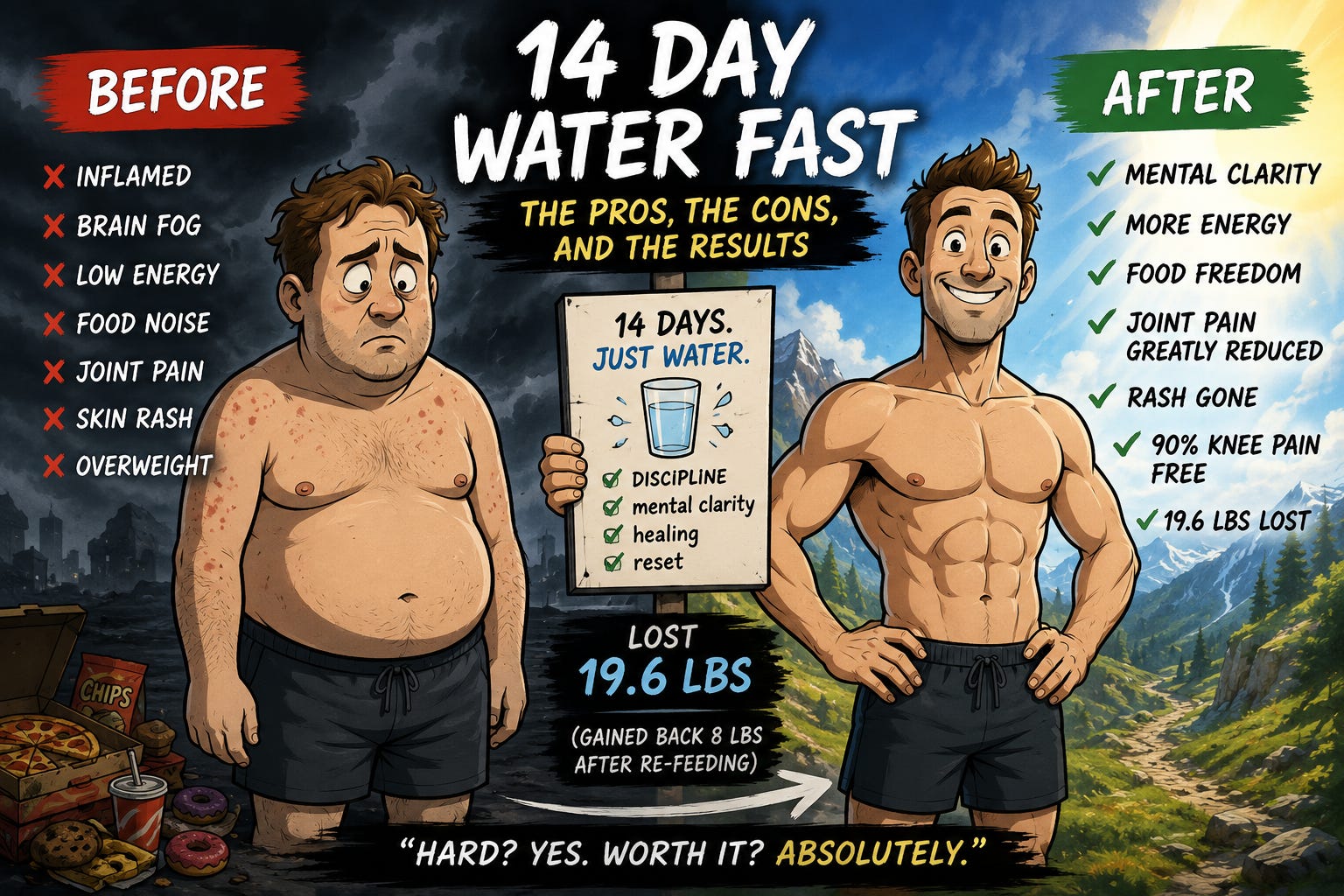
I lost 19.6 pounds during the fast.
Seeing the scale move that dramatically felt surreal. Every morning was like checking my truck’s fuel gauge during a Middle Eastern war.
Now obviously, some of that was water weight and glycogen depletion. I knew going in that not all of it would stay off permanently.
And it didn’t.
After re-feeding and increasing protein intake again for workouts, I gained back about 8 pounds. But even with the rebound, the overall weight loss was still significant.
More importantly, the fast completely changed my relationship with hunger.
I realized how often I wasn’t physically hungry at all. I was bored. Stressed. Looking for stimulation. Reward. Comfort. Entertainment. Food noise is real. And fasting turns the volume way down.
At first, your brain throws a tantrum like a caffeinated raccoon locked outside a convenience store. But after several days, something shifts, and the cravings lose authority.
To be honest, that was a lot more valuable than losing a few pounds.
Mental Clarity
I expected to feel foggy and miserable for two weeks.
Instead, after the rough first few days, I experienced periods of mental clarity that felt almost eerie.
My focus improved. My thoughts felt calmer. My mood became steadier.
It was like somebody cleaned the windows of my soul, and I could see out again.
I’m not claiming I became an enlightened mountain sage who communicates with the birds and can see noises. But there was definitely a noticeable reduction in mental clutter.
Without constantly thinking about meals, snacks, digestion, blood sugar swings, or what I was going to eat next, my brain definitely had a lot more free bandwidth.
There’s also something psychologically powerful about voluntarily doing something difficult. About choosing not to eat, and finding out that I didn’t die after all, or even feel all that bad. I was constantly surprised by how little difference there was in my overall physical condition.
Every day completed became proof that I could tolerate discomfort without immediately trying to escape it.
That lesson leaks into other areas of life.
The Healing Effects Surprised Me the Most
This was the part I hoped for, but really didn’t believe would come true. I had read online and seen YouTube videos where people gave their accounts of pretty incredible healing effects. It was a big reason why I had the motivation to keep going. I’m glad I did, because it was totally worth it.
Several weeks after completing the fast, my skin rash still hasn’t returned.
That alone shocked me.
I also noticed massive improvements in gluten sensitivity. Before the fast, certain foods seemed to trigger inflammation almost immediately. Afterward, my reactions became far less severe.
My hip pain improved dramatically.
And my knee, which had been bothering me consistently, is now about 90% pain free.
The knee pain was slowly but surely ruining my happiness. I had tried so many physiotherapists, massage therapists, heat, cold, supplements, exercise, foam rolling, stretching, red light therapy, acupuncture, and even reiki energy healing. Nothing worked; my knee hurt every day.
So, finding something that could help is a real reason to celebrate! And a reason to do a fast here and there and make it stick.
Now, I’m not claiming fasting is a magical cure-all forged by ancient wellness wizards under a blood moon.
But something clearly changed.
Reducing inflammation, temporarily eliminating irritating foods, pausing digestion, losing weight, and giving the body a break may have contributed to the improvements. The fabled autophagy, where the body targets dead or unhealthy cells and eliminates them in a cleanup process, was probably a big part of it. And I may have dumped a whole bunch of inflammatory toxins out of the system, too.
Whatever the exact mechanism, the results were real enough that I couldn’t ignore them.
The Social Side Was Weird
One thing nobody talks about enough is how strange fasting feels socially.
Food is woven into almost every human interaction.
Work lunches.
Dinner with friends.
Coffee shop meetings.
Suddenly, you realize how often eating is the event itself. I got invited out for lunch during the fast and sat there drinking green tea while everyone else ate burgers.
That experience is psychologically fascinating for about four minutes. Then it becomes a slow-motion culinary hostage situation.
You notice every smell. Every crunch. Every fascinating meal was temptingly carried past the table like a parade of “you can’t have this!”
People also became deeply concerned about me.
Some respected the discipline. Others looked at me as if I were preparing to take on a pack of rabid clowns. Completing a long fast gives you instant street credibility with certain people. The reactions ranged from admiration to confusion to “you’re completely insane.”
The First Few Days Were Rough
The opening stretch was easily the hardest part physically.
I dealt with headaches, fatigue, low energy, and occasional dizziness. Climbing stairs sometimes felt like I was ascending Mount Doom carrying a refrigerator, and my body clearly did not love the transition.
But. Electrolytes helped, hydration mattered, and resting became important.
By the middle portion of the fast, things stabilized significantly. But those early days were a reminder that fasting is not a glamorous productivity hack that instantly makes you laser-focused and superhuman.
Sometimes you’re just a tired person slowly staring into the distance, thinking about food. I spent a lot of time planning what I was gonna eat someday, watching cooking videos, and fantasizing about soup.
Exercise Took a Back Seat
I also couldn’t train properly.
Light walking was manageable, but intense workouts were off the table. Strength, explosiveness, and recovery all dropped significantly, and that’s one of the major trade-offs people should understand.
A prolonged water fast is not compatible with high-performance athletic training. Your body is conserving energy. It is not trying to set personal records in the gym.
And yes, certain “systems” in the body temporarily entered what I can only describe as hibernation mode.
The bedroom department essentially hung up a “Closed for Maintenance” sign until re-feeding was well underway.
Apparently, reproduction becomes less urgent when your body thinks you’re wandering through a food desert after the apocalypse.
Was It Worth It?
Absolutely.
It was worth it because it forced me to confront habits, cravings, discomfort, and emotional attachment to food in a very direct way. It also delivered real physical improvements that have continued weeks later.
The rash hasn’t returned.
My hip feels great.
My knee pain is mostly gone.
My relationship with hunger has changed.
And mentally, I feel more disciplined around food than I have in years.
Would I do another 14-day water fast tomorrow?
Definitely not.
Right now, I’m focused on rebuilding strength, hitting protein targets, and training properly again.
But I’m very glad I completed it. The experience taught me something important:
A lot of what we think is hunger is actually habit.
A lot of what we think is weakness is discomfort.
And sometimes your body needs less chaos, not more optimization.
Also, if you do a 14-day water fast, don’t hang out with your buddies on pizza night.
That’s just tactical stupidity. 🍕
I’m looking for 5 people who are tired of feeling stuck with their health.
If you want to:
• lose weight
• control cravings
• build better habits
• improve energy
• feel stronger and more confident
…I’d like to help.
No extreme diets. No “detox tea wizardry.” No punishment workouts from the fitness underworld.
Just practical coaching, accountability, and sustainable changes that actually fit real life.
If you’re serious about making a change, hit the button below!
I have a friend who does fasts, usually 7-11 days. Me - never! Only for my colonoscopy. Would I do an actual fast... I don't know, but you've inspired me to start thinking about it. GO YOU for going all in and doing it for 2 whole weeks. Impressive.
Admirable, Tim. I heard about it but didn't know much. I wonder, would one week be sufficient? Two weeks seems a long time to me, would half that time still result in positive feedback?